Tuesday, September 9, 2014

Mothering in the Mire: For the Mother of Mike Brown and Black Mothers Everywhere


One month ago, today, Michael Brown Jr. was shot and killed in Ferguson, Missouri.  I sat down to write this post several times within the last month, but could not bring myself to do it. I was inundated with Facebook statuses, tweets, instagram pictures and the like, about this tragic shooting.  But what could I say?  What should I say?  I turned on the television and people aching for justice were met with tear gas, tanks and other methods of brute force, as if they were adversaries!  As each day passed, it became more difficult to process that it was 2014 and not 1964. 

I still have so many questions.  Two that remain are:

1. What about the mother of Mike Brown? AND
2. How much trauma can one group of people take?
(I do not know how to even begin to deal with the second question, so I will focus on the first.)


While I am not yet a mother, I have the capacity to become one.  As a black woman, whose body can produce black children, I could not help but wonder if someday, I might stand in the shoes of Ms. Lesley McSpadden, mother of Mike Brown.  I wondered on the one hand, about the courage it takes to raise a child in a land not created for them and on the other hand, I commended the courage of black mothers to keep doing so.  Black mothers keep mothering, even though "every 28 hours a black person is killed by a police officer".  Black mothers keep mothering, even though our children are being killed while in handcuffs (Oscar Grant), for wearing a hoodie (Trayvon Martin), for listening to music (Jordan Davis), for asking for help (Renisha McBride) or while walking down the street (Mike Brown). Black mothers keep mothering black children, even though we live in a society, which fears black skin.  I wrestled with this feeling of hopelessness and wondered if I could ever become a mother, given this reality.  


It was during this time that I came across an old (April 2014) Essence magazine article by Melissa Harris-Perry entitled “Mother’s Day.”  She recounts the death of Jordan Davis, an unarmed African-American male shot and killed in the backseat of an SUV in Florida for playing rap music.  In this article, she mentions having met the mother of both Jordan Davis and Trayvon Martin, in a close time frame.  She writes,

“It is impossible to be a Black Woman in America without wondering, at times, if our country hates the ones we love.  It would be easy to allow the grief of our recent losses or the history of Black life in America to make us shun the task of mothering.  We have inherited the historic audacity of Black mothers in this country.  We have dared to create families, to embrace our beloveds, to bear our children and to pour our whole selves into them even when we know that a hateful world awaits.  To love our children without reservation is an act of courage—one that was passed down to us, and one that we must continue.”

*Photo taken at Howard University: "Hands Up, Don't Shoot"
While I agree with Harris-Perry that we must remember the historical narrative of the black mother’s audacity, and the current narrative of the black mother’s continued courage, (especially in light of these not-so-new racialized realities), I would like to add to her argument. For me, there is also a theological narrative, which gives us hope.  It is this: We (black women) are a part of God's story, because we are a part of human history.  If God put us in the story, God surely put our children in the story.  Therefore, we must also come to see black mothering/child-rearing as the continued work of God.  If this is so, in like manner, we ought see our children as indeed, bearing the image of God (Gen. 1:27).  This means that the lives of not only black parents, but also black offspring are and will always be valuable—even when the world at large decides otherwise.   
 #MikeBrown #DontShoot #Godtalk #BlackMothers #blacklivesmatter  #GodMadeTheSkinImIn


Monday, March 10, 2014

Is Feminism Flawless? —A Commentary on the Complexities of Womanhood


Feminist: One advocating social, political, legal, and economic rights for women equal to those of men.  It seems that the conversation around what it means to be a feminist has always either elicited concord or conflict.  For example, in December, shortly after Beyoncé’s release of her fourth music album, I came across a blog article titled: “The Problem with Beyhive Bottom Bitch Feminism.”  There followed a thread of over 400 comments from women of various ages, wrestling with the very definition of feminism.


But feminism isn’t flawless.  When constant questions are raised as to whether artists like Nicki Minaj and Beyoncé are feminists, I am reminded of this.  In fact, while some like to romanticize the details of the feminist movement and assert that women across color and circumstance were on one united front advocating for the equality of all women, the contrary is true.  Black women were not included in the definition of woman.  Works like Sojourner Truth’s “Ain’t I A Woman?” manifest the black woman’s unapologetic struggle for her society to view her as fully woman.  In fact, many scholars deemed the plight of the black woman in a majority white world, a “double bind.”  Essentially, as stated by Anna Julia Cooper, black women were “confronted by both a woman question and a race problem.”  Therefore, given that the aims of the feminist movement excluded black women, I wonder if any black woman— Ms. Minaj, Mrs. Knowles-Carter or otherwise, can truly call herself a feminist.


In addition, women deserve the freedom to create our own definitions of womanhood.  Some may desire to express that meaning by using the words: feminist, black feminist, womanist or none of the above.  And that’s just fine!  Our true power lies in our ability to define womanhood on our own terms.  Moreover, the benefit is that each of these terms may challenge us to think of womanhood in ways that we hadn’t before. 


In one of her essays, bell hooks discusses the representation of the black female body in popular culture.  For hooks, she is empowered when notions of womanhood “subvert sexist and racist representations” that have pervaded our society.  While this is an honorable and necessary task, does it force women into a sort of existential straight-jacket?  If a woman constantly engages in overturning images, which undermine her gender or sexuality, is there any middle ground?  For example, a woman may say that she refuses to marry because she does not want to support the sexist institution of patriarchy.  Or is there a way for her to operate within the system (institution of marriage) and be an equal to her husband?  Or if a black woman refuses to wear a mini-skirt and halter top for the sake of not upholding the “black woman as Jezebel” stereotype, where is her freedom to dress as she pleases?  For me, the freedom lies in the ability to create and recreate a personal definition of womanhood as often as needed.  While subversion of “racist and sexist” images is important, my definition of womanhood cannot stop there.  If it does, I am merely tip-toeing around the meaning of womanhood (which includes sexuality) as opposed to embracing it! 


Also, it seems that being a woman is difficult.  While there are days that it comes with ease, there are also days that being a woman comes with struggle.  Maya Angelou confirms this for me.  She writes, 

Being a woman is hard work. Not without joy and even ecstasy, but still relentless, unending work. To become and remain a woman commands the existence and employment of genius. The woman who survives intact and happy must be at once tender and tough. She must have convinced herself, or be in the unending process of convincing herself, that she, her values, and her choices are important. In a time and world where males hold sway and control, the pressure upon women to yield their rights-of-way is tremendous. And it is under those very circumstances that the woman's toughness must be in evidence.


In our struggle to be women, we must remember that we are human.  We do not possess all of the answers of what it means to be a woman.  If we had all of the answers, what need would we have of the Divine Mother’s spirit to guide us on our journey?  It may be that the definition of womanhood is fluid and not static, growing as we grow.  Perhaps womanhood exists beyond any of the labels that we have imagined.  It may be that it is as breathtaking, as vast and as mysterious as the horizon.


Wednesday, January 1, 2014

Letting Go of Shame: A Psychoanalytic Reading of The Prodigal Son


Series: Diary of A Divinity Student (Entry #4)


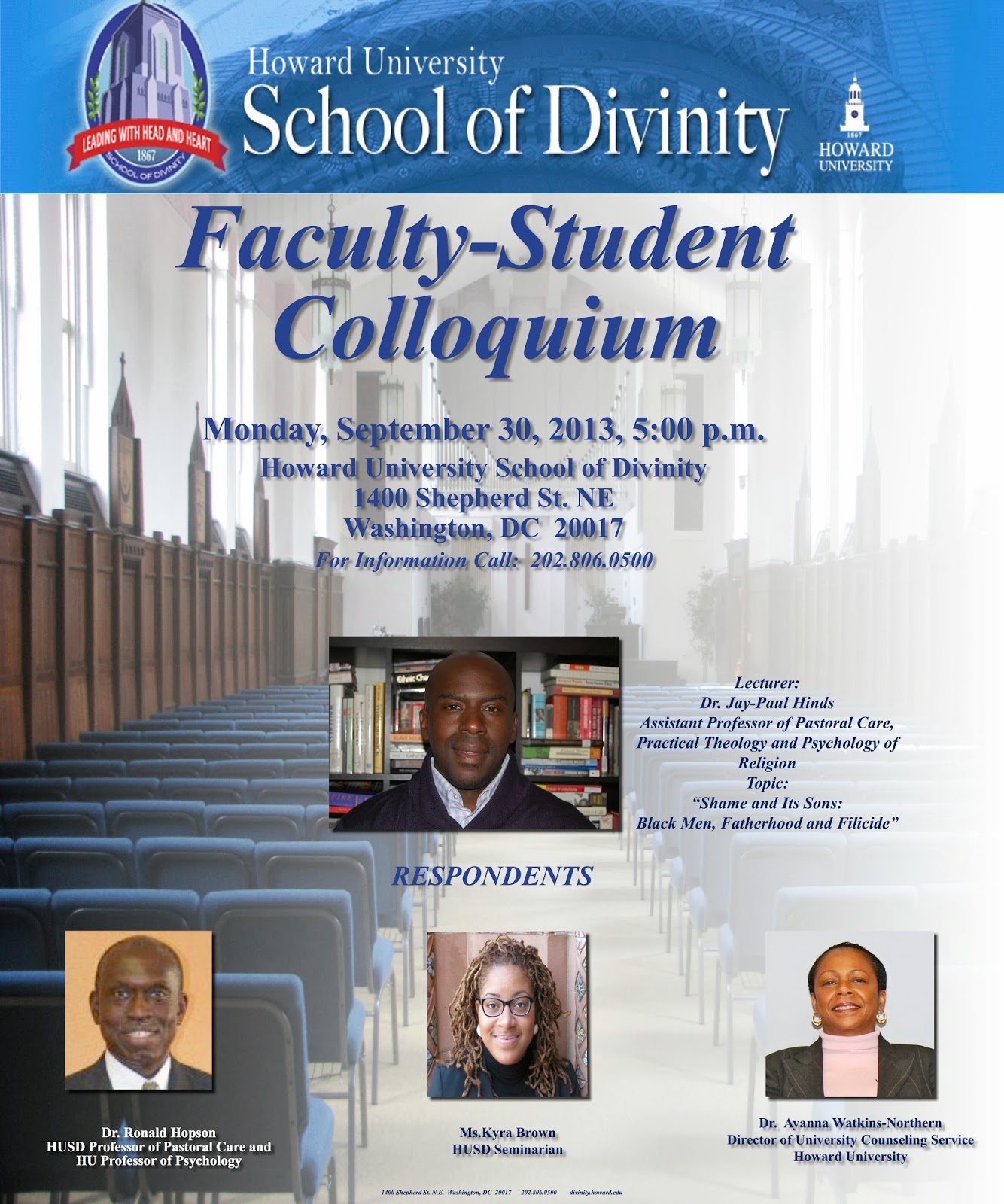
This past semester, I participated in a Student-Faculty Colloquium at Howard University School of Divinity.  I was a student-respondent among three faculty-respondents.  This exercise allowed me to further explore an area of great interest: the intersection of psychology and religion.

(A Response to Dr. Jay-Paul Hinds’ “Shame and it’s Sons: Black Men, Fatherhood and Filicide”)

    What is filicide?  Upon preparing my response, I asked myself this question.  As a result, I could not help but notice that Christ, himself, was a victim of filicide.  According to the Christian story, we are saved by a Father, who begat a son, and killed that son (by way of the cross).  While we emphasize Christ’s degradation and use it as a source of empowerment that invites us to a personal faith-journey of metamorphosis, there is something quite unsettling about this model.  While Dr. Jay-Paul Hinds, in his paper, “Shame and Its Sons: Black Men, Fatherhood and Filicide”, asserts the contrary, it is my opinion, that shame is not a secure base from which to nurture our sons and daughters in the black community.  We are surrounded by a culture of shame.  Furthermore, shame is a complex emotion and it is unrealistic that wholeness can come from such a broken place.  In this response, I have identified the following three areas of shame: theological, societal and familial. 

First, our sons and daughters are oftentimes exposed to a theological shame, as a result of church upbringing.  We are taught that we are to be ashamed of our “sinful” human nature, and that is in fact, proof that we are in need of a savior.  I am reminded of the short story, by Langston Hughes, entitled, “Salvation,” which depicts a thirteen-year-old boy, who was shamed into salvation, if you will.  In fact, our shame is two fold.  Not only are we made to feel a sense of self-disgust as a result of our “sinful” human condition, we are also reminded of the shamefulness of the cross.  Christ sacrificed his shame for our own. Songs such as “I Know It Was The Blood,” further prove this point:

They nailed him to a tree; they nailed him to a tree for me. 
They pierced him in his side; they pierced him in his side, for me. 
One day when I was lost, he died upon the cross and I know it was the blood for me.

Essentially, we are taught that we must admit our shameful shortcomings, accept the gift of salvation, or Christ’s shameful crucifixion was in vain. 


Second, our sons and daughters, growing up in the United States, encounter a societal shame.  It is the shame of bearing black skin.  We live in a land, which enslaved, lynched, and segregated our ancestors, and in many ways still seeks to oppress us today.  Let us take the recent, story of Trayvon Martin, for example.  Many of us know the story.  He was a black, young male, walking through a white neighborhood, on his way to purchase iced tea and skittles, never to return.  And sadly, in our society, such degradation of black males is not uncommon.  Or, for our daughters, beyond the skin, there is a shame attached to black hair.  I am reminded of Tiana Parker, the teary-eyed six-year-old girl in Tulsa, Oklahoma sent home from school because the school “banned natural hairstyles such as afros and dreadlocks.”  Due to these underpinnings of theological and societal shame, I argue that this emotion is not a foundation of familial empowerment for our sons and daughters in the African-American community.  


 *Trayvon Martin and Father, Tracy Martin

However, I applaud Dr. Hinds’ use of a biblical paradigm to shed light on family dynamics and issues of mental health.  This is often a taboo topic in the black community.  Moreover, I hold that in the story of the prodigal son, the father is a starting point for analysis of the family structure, not the answer to it. 

Third, Hinds asserts that for both father and son, mutual shame or vulnerability can serve as a platform for empowerment.  Namely, Hinds assumes that the father is in a healthy enough place to relate to his son, to begin with.  Given the social issues surrounding the father-son dynamic, in our context today, of which Hinds states its effects adequately and with much analysis, the end goal of reconciliation by way of mutual vulnerability seems to understate the complexity of the issue.  Next, Hinds assumes that the father is aware of his own shame and willing to admit how it has impacted the father-son relationship.  The father must do his own internal work before attempting to address the son’s.  As the father, he may not be ready to undergo such a difficult process of self-introspection.  Especially, if his own shame as a son (the father) has not been addressed in his own life.  If the father and son come to a healthy place were reconciliation is possible, it will not come from a place of familial shame.  The father is not all encompassing, possessing all of the answers that the son needs for his own development.  For me, this solution echoes the paternalistic-patriarchal model of our theology.  Perhaps some of the questions we ask God, we hold the answers to.   Perhaps the son has more to say than the parable exemplifies. 


           *The Return of The Prodigal Son by Romare Bearden 
 
From what place should fathers relate to their sons and daughters?  In the story, maybe the father did the right thing in not addressing his son’s inner shame.  Maybe the father was aware of what he COULD provide: monetary as opposed to emotional support.  Perhaps the task for the lost son or daughter is to realize what the father can provide—if anything.  Perhaps it is why the prodigal child took the voyage to begin with.  Throughout our lives as sons or daughters, we will leave home many times.  We will leave in search of a community drastically different from the one in which we were raised.  Or, if the home is a toxic place, one’s journey may not permit them to return home often.  Theological, societal and familial shame are not springboards for hope.   In this case, maybe a healthy home is more psychological than physical. Perhaps this was the case for the prodigal son. Perhaps this (realization) is the place from which growth can occur. 


Sunday, October 13, 2013

DARE to BE NATURAL!


“Hairstyles such as dreadlocks, afros, mohawks and other faddish styles are unacceptable.”  These were the words in the student handbook at Deborah Brown Community School located in Tulsa, Oklahoma.  On September 11, 2013, seven-year-old Tiana Parker, a student of this school, was sent home because her hair was deemed “unacceptable.”  Her story illustrates that in America, there remains a prevailing perception that black hair is not beautiful in its natural state. 

 Tiana Parker, Age 7

Moreover, this issue affects not only black women and girls, but black boys and men, also.  In fact, Hampton University, since 2001, has banned dreadlocks and cornrows for students (male and female) enrolled in their MBA program.  Sid Credle, the Dean of the Business School, asserts that the ban exists so that students can secure employment in the corporate arena.  But what makes black hair unacceptable or unprofessional?  I have been asking this question for years, and I have never received a satisfactory answer.     

Although naysayers criticize our hairstyles, it seems that we are regarded as unpresentable, unprofessional, and therefore, unacceptable, by virtue of our hair texture.  But by what standards is the beauty of black hair being measured?  In most cases, it is the white standard of beauty.  Although the DNA of our hair is structurally different, somehow we are pressured to imitate white standards of beauty, wear our hair as straight as possible, to mirror the hair texture of the dominant culture.  And if we do not comply, as with the case of Tiana Parker, there are repercussions.  Even, India.Arie’s “I Am Not My Hair” seems to be in defense of her natural, kinky hair texture. 

I want to share this poem I wrote, inspired by my own hair issues and those of some of my former students.  I hope that it will inspire you, or a woman you know.  I hope that it will move you to love your Creator, love Yourself and to love your Hair—texture and all.

 Me, DARING to be NATURAL!

hair peace

for Nancy, Janae and kinky-haired girls everywhere

as you
toil through
tears, comb
courageously
through tangled
standards
of beauty,
may you
realize your
hair's texture
needs no
apology.

as you
brush bravely,
through knotted
insecurity,
battle the
definition
of beautiful,
may you
realize your
hair's heavenly
and
needs no
Miracle*.

*Line of hair products for black women called "Dr. Miracle."

2/2011 

           Dr. Miracle Advertisement

Monday, September 2, 2013

Be Open: On Discerning the Journey


I am convinced, that life is one great journey to self.  With each experience, I have felt the essence of my true self emerge.  It seems that some experiences, more than others, have served as checkpoints on the road of life.  These checkpoints have lead me to reflect on the journey and discern where to go next.  However, I have learned, that just as one who is not familiar with a geographic area is unfit to give directions to a traveler, in the same way, everyone cannot give directions in my discernment process, because everyone does not know the terrain of my heart.  


I spent much of the summer wrestling with this question: “What do I want to do with my life?”  It was then that I remembered having this same conversation four years ago, with a mentor of mine.  She lovingly said, “Kyra, when you figure out WHO you want to be in the world, the WHAT will fall into place.”  Instantaneously, her words brought peace to the tempest in my mind.  However, this summer, I struggled to answer the a newfound question, “Who do I want to be in the world?” 

Not long after asking this question, I came across artist, Martha Graham’s quote:


“There is a vitality, a life force, an energy, a quickening that is translated through you into action.  And because there is only one of you in all of time, this expression is unique.  And if you block it, it will never exist through any other medium and be lost.  It is not your business to determine how good it is, nor how valuable,  nor how it compares with other expressions.  It is your business to keep it yours, clearly and directly, to keep the channel open… Whether you choose to take an art class, keep a journal [or start a blog], record your dreams, dance your story or live each day from your own creative source, above all else, keep the channel open!”


       On this journey, I will face moments of discernment many times over.  Like the many surfaces of a diamond, which exude light from every angle, throughout my life, I will uncover the many facets of my true self, and “from my own creative source,” reflect my unique essence.  I believe that is who I want to be in the world.  A woman who is true, a woman who is creative, a woman who is open.    


Tuesday, June 11, 2013

"Or Should I Reprogram the Programming and Get Down?"—A Lesson from Janelle Monae (A Seminarian’s Perspective)

 
 Series: Diary of A Divinity Student (Entry #3)

I have just completed my second year of seminary.  This is what some refer to as the “muddy middle” year.  The year that many students buckle under the pressure of reformulating a self-identity that was once anchored in waters of religious traditions, doctrines and denominations. The year that many of us struggle to find balance on a theological tightrope of sorts, swaying between a space where old ways of thinking no longer suffice and new theologies have yet to be constructed.  During my time of reflection, something lead me to read an email I received about two years earlier from a colleague who had also gone to seminary.  He asked, “Are you in seminary to be trained for a calling or clarify your calling?”  Looking back, I think it is a little of both.

  
During dead week this past semester, I came across a song called “Q.U.E.E.N.” by Janelle Monae, featuring Erykah Badu.  I believe that she has some pertinent theological advice for everyone, especially those of us in seminary.  Her song, laden with religious imagery, explores themes such as: the price of pursuing one’s passion, the correlation between sin and sexuality (if there is one), the concepts of salvation, heaven, and human acceptance, sexual identity (to include same-gender loving people) and salvation, and God’s acceptance of who we are, just the way we are—in our true authenticity.  She writes,


Hey brother, can you save my soul from the devil?
Say is it weird to like the way she wear her tights?
And is it rude to wear my shades?
Am I a freak because I love watching Mary? (Maybe)


Hey sister, am I good enough for your heaven?
Say will your God accept me in my black and white?
Will he approve the way I'm made?
Or should I reprogram the programming and get down?


Amidst the message-ridden lyrics, thought-provoking images and the funky beat, this question would not escape me!  It is my interpretation that, “programming” is a synonym for religious teaching/indoctrination.  "Reprogramming" means reevaluating and recreating these teachings.  “Getting down” then, is a metaphor for discovering personal freedom/living in true authenticity.  As a major part of our culture and socialization, we have been taught many religious principles.  This process (with due respect) has shaped much of who we are.  However, there comes a time where we have the option of reexamining what we believe, discarding beliefs, theologies, doctrines and traditions that no longer promote our growth and embracing those that do.  In my view, Janelle Monae is encouraging all of us not to be afraid of this creative process of re-drawing boundary lines (freeing ourselves) in all areas of our lives.  On the road to self-discovery and living in true authenticity, (finding this place has been the crux of my seminary experience), I concur with Janelle Monae that we should… “Reprogram the programming and get doooown”!  Perhaps THIS is where we will meet God.


Wednesday, January 30, 2013

Twice in A Lifetime: A Reflection on the 2013 Presidential Election


I remember watching his speech at the 2004 Democratic National Convention in my high school Leadership class, and my teacher, insinuating that the then, Senator, was “going somewhere.” I remember meeting him at Congressman John Lewis' 65th birthday celebration (in conjunction with the 50th anniversary of Bloody Sunday), held at a Georgia hotel, as a high school junior.  I remember quoting him in the ultimate line of my high school commencement speech.  Lastly, I remember, as a college undergraduate, celebrating his election as the first African American President in US history, on U Street in Washington, DC.  Naturally, as I stood on the national mall this past Martin Luther King, Jr. day, awaiting the ceremony for President Barack H. Obama's second inauguration, this sequence of events, like waves returning to a faithful shore, ceased to dissipate in my mind.   

As the crowds increased, I sensed that the moment I was waiting for, the moment we were waiting for, was finally near.  To my front, the sun embraced the sherbet sky, just behind the capitol building.  To my left, college students sat on the ground playing a game of cards.  To my right, a pre-teen sipped hot chocolate while huddled next to his mother.  Behind me, the elders sat in foldout chairs, bundled under sleeping blankets.  We were all waiting.  It was indeed a sacred moment.  
          In fact, what was quite memorable was the prayer of Mrs. Myrlie Evers-Williams.  Her prayer brought me to tears.  It seemed to be deeply heartfelt—as if she encapsulated the very pulse of history, which resided 50 years before, in the heart of her husband, murdered civil rights activist, Medgar Evers.  I imagine that in stopping to honor God for such a moment in history, she was simultaneously honoring the life and legacy of her late husband who was killed because he was organizing, that blacks might have the right to vote.  This very occasion (the second inauguration of our first African-American president) was the summation of that right coming to fruition.


 I was further awestruck that President Obama pledged on the two Bibles: one of President Abraham Lincoln and that of Dr. Martin Luther King, Jr.!  In that moment, I was reminded of the importance and power of prophetic leadership (I’ll have to expound upon this concept at another time).  I am truly grateful for what I witnessed on the National Mall, that day.  God only knows where I’m going from here.